German verb “sein”: Full conjugation in every tense and mood

German verb “sein”: Full conjugation in every tense and mood
What is conjugation? Conjugation means the way verb changes its form to express different tenses, moods, or Person.
When we conjugate a verb, we modify its for often by adding an ending. For example, in English you simply add an “s” for the third-person singular: “I live” becomes “she lives.”

English keeps things pretty simple. But in German, we will quickly notice that verbs transform in many more ways. Don’t worry—we’ll guide you through each pattern as we explore the conjugation of the German verb “sein” (to be).

The verb “sein”:

“Sein” means “to be,” and it is used in German to express everything from emotions and physical states to identity. That is why mastering its conjugation is very important.

We need the verb sein to make some of the most basic statements like…

  • Expressing’s one’s emotions: Ich bin traurig. (I am sad)
  • Telling about colour of something: Die Blumen sind rot. (The flowers are red)
  • Asking for the bathroom: Wo ist das Badezimmer?
  • Using and adjective to describe anything: Ein Kaffee wäre toll!

Conjugation of the verb “sein”:

“Sein” is a irregular verb as most of the important verbs in German language are irregular verbs. The best way to understand the verb is to study and memorise each form of the verb by itself. So lets see the table for each tense.

Present Tense:

The present tense, known in German as Präsens, is often considered the most crucial tense. German has only one present tense, whereas English distinguishes between simple present and present progressive forms.

If you need the tone adjusted for a blog, lesson, or Instagram post, I can customise it!

English

German

Example Sentence

Translation

I am  

Ich bin

Ich bin glücklich

am happy.

You are

Du bist

Du bist lieb.

You are nice.

He/She/It is

Er/sie/es ist

Er/sie/es ist hier.

He/she/it is here.

We are

Wir sind

Wir sind Freunde.

We are friends.

You are (pl)

Ihr seid

Ihr seid lustig.

You are funny (pl).

They are

Sie sind

Sie sind Schüler.

They are students.

 Simple past tense:

In German, the simple past tense describes actions that took place in the past and are already finished. This tense is referred to as the “Präteritum” or “Imperfekt.”

English

German

Example Sentence

Translation

I was

Ich war

Ich war hier

I was here.

You were

Du warst

Du warst da.

You were there.

He/She/It was

Er/sie/es war

Er/sie/es war erfolgreich

He/she/it was successful.

We were

Wir waren

Wir waren Schlau.

We were clever.

You were (pl)

Ihr wart

Ihr wart laut.

You were loud (pl).

They were

Sie waren

Sie waren schön.

They were beautiful.

Present perfect tense:

The Present Perfect is used to describe about past actions or events that are relate to the present tense    . In German, this tense is called “Perfekt” and is created by combining the auxiliary verbs haben (to have) or sein (to be) in the present tense with the verb’s past participle.

  • Ich habe gearbeitet.(I have worked)
  • Ich habe gefargt.(I have asked)

English

German

Example Sentence

Translation

have been

Ich bin gewesen

Ich bin einkaufen gewesen

have been shopping.

You have been

Du bist gewesen

Du bist krank gewesen.

You have been sick

He/She/It has been

Er/sie/es ist gewesen

Er ist da gewesen.

He has been there.

We have been

Wir sind gewesen

Wir waren pleite gewesen.

We have been broke.

You have been (pl)

Ihr seid gewesen

Ihr seid nett gewesen.

You have been nice (pl).

They have been

Sie sind gewesen

Sie sind hier gewesen.

They have been here.

We can form the present perfect tense for the German verb sein, since these are the auxiliary verbs that we need to build the tense itself (e.g., Ich habe gehabt / Ich bin gewesen). Instead, present perfect is  used with more verbs that describe actions.

Example Sentence

Translation

Ich habe Essen gekocht.

I have cooked Food.

Wir haben das Buch gelesen.

We’ve read the Book.

Du hast deine Prüfung bestanden.

You’ve passed your exam.

Ich habe aufgeräumt.

I’ve cleaned up.

Du hast nicht angerufen.

You haven’t called.

Sie hat dich gefunden.

She has found you.

Past perfect tense:

The past perfect tense is called as the “Plusquamperfekt” in German—another long German word in German Language!

To form the sentence we using the past participle of the main verb  with the auxiliary verbs haben (to have) or sein (to be), but the auxiliary verbs are conjugated in simple past:

  • Ich hatte gearbeitet (I had worked)
  • Ich war gegangen (I had walked)

This tense takes you even further back in time than the simple past. You typically use it when telling a story and want to mention something that happened earlier:

Ich war gerade dabei, in den Bus zu steigen, als ich merkte, dass ich mein Ticket zu Hause vergessen hatte.
(I was just about to get on the bus when I realized that I had left my ticket at home.)

English

German

Example Sentence

Translation

had been

Ich war gewesen

Ich war treu gewesen

had been loyal.

You had been

Du warst gewesen

Du warst drüben gewesen

You had been over there.

He/She/It had been

Er/sie/es war gewesen

Er/sie/es war müde gewesen

He/she/it had been tired.

We had been

Wir waren gewesen

Wir waren schlau gewesen.

We had been clever.

You (pl) had been

Ihr wart gewesen

Ihr wart laut gewesen.

You had been loud (pl).

They had been

Sie waren gewesen

Sie waren schön gewesen.

They had been beautiful.

Future tense:


To write a sentence in future tense in German — known as “Futur I” — you use the auxiliary verb werden in the present tense, followed by the infinitive of the main verb.

Examples:
Ich werde lachen – I will laugh
Ich werde gehen – I will go

English

German

Example Sentence

Translation

will

Ich werde

Ich werde hier sein

I will be loyal.

You will

Du wirst

Du wirst drüben sein

You will be great.

He/She/It will

Er/sie/es wird

Er/sie/es wird laut sein

He/she/it will be sucessful.

We will

Wir werden

Wir werden schlau sein.

We will be clever.

You will (pl)

Ihr werdet

Ihr werdet laut sein.

You will be loud (pl).

They will

Sie werden

Sie werden schön sein.

They will be pink.

Future perfect tense:


The German future perfect tense, known as “Futur II,” is used to talk about actions that will have been completed at a certain point in the future.
To build this tense, you use the auxiliary verb werden in the present tense, followed by the past participle of the main verb and the appropriate form of haben or sein.

Examples:
Ich werde gelacht haben – I will have laughed
Ich werde gegangen sein – I will have gone

English

German

Example Sentence

Translation

I will have been

Ich werde gewesen sein

Ich werde hier gewesen sein.

I will have been here.

You have been

Du wirst gewesen sein

Du wirst toll gewesen sein.

You will have been great.

He/She/It have been

Er/sie/es wird gewesen sein

Er/sie/es wird erfolgreich gewesen sein.

He/she/it will have been successful.

We will have been

Wir werden gewesen sein

Wir werden schlau gewesen sein.

We will have been clever.

You will have been(pl)

Ihr werdet gewesen sein

Ihr werdet laut gewesen sein.

You will have been loud (pl).

They will have been

Sie werden gewesen sein

Sie werden rosa gewesen sein.

They will have been pink.

Subjunctive:


In German, the subjunctive is “Konjunktiv.” It refers to a grammatical sentence construction used to express uncertainty, possibility, or hypothetical situations.
For example: Did some one say Vacation? That would be wondeful!

English

German

Example Sentence

Translation

will

Ich werde

Ich werde morgen lernen

I will work tomorrow.

You will

Du wirst

Du wirst pünktlich sein

You will arrive on time.

He/She/It will

Er/sie/es wird

Er/sie/es wird laut sein

He/she/it will be sucessful.

We will

Wir werden

Wir werden zusammen essen

We will eat together.

You will (pl)

Ihr werdet

Ihr werdet das verstanden.

You all will understand that

They will

Sie werden

Sie werden morgen fahren.

They will travel tomorrow.

Konjunktiv I:

Konjunktiv I is primarily used in formal contexts, especially for reported speech and indirect commands. For example, when someone says, “My mom said I was really smart,” that’s reported speech — and we’re not sure whether it’s actually true!

English

German

Example Sentence

Translation

(They said) I was

Ich sei

Man sagt, ich sei schlau.

One says I was smart.

(They said) you were

Du seist

Man sagt, du seist leichtgläubig.

One says you were gullible.

(They said) he/she/it was

Er/sie/es sei

Man sagt, es sei kalt draußen.

One says it was cold outside.

(They said) we were

Wir seien

Man sagt, wir seien freundlich..

One says we were friendly.

(They said) you were (pl)

Ihr seiet

Man sagt, ihr seiet höflich.

One says you were polite.

(They said) they were

Sie seien

Man sagt, sie seien Diebe.

One says they were thieves.

Konjunktiv II:

Konjunktiv II form is used to talk about mostly hypothetical situations or wishes, or polite expressions. For example, when you think, “If we saved more Money, we would buy a new ,” you’re using this form.

English

German

Example Sentence

Translation

I would be

Ich wäre

Dann wäre ich glücklich.

D Then I would be happy.

You would be

Du wärst

Dann wärst du neugierig.

Then you would be curious.

He / she / it would be

Er/sie/es wäre

Dann wäre sie dabei.

Then she would be with us.

We would be

Wir wären

Dann wären wir schlauer.

Then we would be smarter.

They would be

Ihr wäret

Dann wärt ihr Ärzte.

Then you would be doctors.

You would be (pl)

Sie wären

Dann wären sie Katzen.

Then they would be cats.

The imperative form in German:


The command form, or “Imperativ,” is used to tell someone what to do — or in this case, what to be. It only differentiate  between the singular and plural form of the verbs


English

German

Singular

Be happy!

Sei glücklich!


Be kind!

Sei lieb!


Be yourself!

Sei du selbst!

Plural

Be good!

Seid gut!


Be loud!

Seid laut!


Be yourselves!

Seid ihr selbst!

Final Thoughts

So, if you  are curious about such type of verbs ,the process of learning German language grammar will be a lot more fun. With the right mindset, resources, one can explore some more marvels and peculiarities at our German language class in Pune and Pimpri Chinchwad . Start today, stay consistent, and watch your language skills improve.
German Language: Myths, Facts & Easy Learning Tips

German Language: Myths, Facts & Easy Learning Tips

German: Hard or Easy to Learn? Let’s Uncover the Myths and Realities!

Although German may seem complicated at first sight, it provides loads of advantages for those who have English as their mother tongue. You can reduce your learning curve since much of the vocabulary and structures are similar, and grammatical rules are laid out very clearly. In Pimpri-Chinchwad, you’ll find dedicated German language classes that clear up misunderstandings and provide the right tools so that learning German becomes easier.

Is German a hard language to learn?

We often hear: “Is German hard to learn?” The honest answer: it depends. Factors such as your mother tongue, prior foreign-language experience, personal learning style, and motivation all play a role. Some learners pick up languages quickly; others prefer structured courses like one-to-one German lessons in Pimpri-Chinchwad to support their journey.

But the truth is, an English speaker can quite easily grasp the basics of German but to truly master it, it does take more commitment.

Why Some Learners Find German Challenging

Here are five reasons why German can feel difficult:

  1. Grammatical complexity

German contains four cases-nominative, accusative, dative, and genitive-noun declensions and verb conjugations, among many other complexities.

  1. Long compound words

German compounds like “Rindfleischetikettierungsüberwachungsaufgabenübertragungsgesetz” look intimidating — the trick? Break them into smaller parts.

  1. Pronunciation

These include the guttural “r”, “ch”, “ck” and the umlauts (“ä”, “ö”, “ü”) which don’t exist in English and may take practice.

  1. Gendered nouns

Every noun is either masculine, feminine or neuter (der, die, das) – remembering the correct article can be tricky.

  1. Verb placement

In subordinate clauses the verb often goes to the end, unlike the structure in English. Sometimes learners reach the end of a sentence and suddenly realise they haven’t processed the verb yet.

Why German Can Be Easier for English Speakers

German, on the other hand, does have practical benefits for English-speaking tourists, particularly in the Pimpri-Chinchwad region:

  • Shared Germanic roots: English and German both come from the Germanic family, so you’ll find many cognates—words that look and sound similar.
  • Phonetic consistency: Generally, German is spoken as it is written, which makes it easier to pronounce words correctly after learning the sounds and alphabet.
  • Most importantly, resource availability: There are numerous German classes available both online and offline in Pimpri-Chinchwad for classes ranging from A1 to C2. 
  • Familiar alphabet: German is written in Latin script, so there’s no whole new writing system for an English-speaking person to learn.

Common Myths About Learning German

  • “German words are always huge and unmanageable.”

Actually, many compounds can be broken down into understandable parts: “Haus” or “Baum” are simple.

  • “German sounds harsh and ugly.”

While German can have a strong sound, its literature, poetry, and everyday speech have beautiful rhythm and elegance, once you get used to it.

  • “German is rigid and inflexible.”

German, on the other hand, is a language allowing creative expression and variation in sentence structure, especially when one speaks colloquially.

How to Learn German Fast and Efficiently in Pimpri-Chinchwad

Here are some proven tips you can use alongside your German language class in PCMC:

  • Immersion: Surround yourself with German-listen to podcasts, watch German films, speak with classmates. This method accelerates growth.
  • Learn chunks, not just words: Instead of just learning isolated vocabulary, learn phrases and patterns for conversing.
  • Utilize similarities: Learn English/German cognates, such as Mutter for mother and Freund for friend, to increase vocabulary rapidly.
  • Join a structured class: Enrol for local German language classes in PCMC that teach with the CEFR levels like A1, A2, B1, B2, etc. 
  • Achievable goals: Define what you want— travel, study abroad, professional use— and align your classes accordingly.

Is It Worth Learning German?

Of course, German is one of the most important languages in Europe, with many German companies being highly international. It opens doors for great career possibilities, travel opportunities, and cultural exchange. Whether you wish to work in Germany, study there on very favorable conditions, or simply want to add this valuable skill to your portfolio, learning German pays off. Even if it might feel tough sometimes, the benefits far outweigh the effort.

Final Thoughts

So, if you have been asking, “Is German hard or easy to learn?” — the answer is that it’s both, depending on your approach. With the right mindset, resources, and a local German language class in Pimpri-Chinchwad, you will find learning German quite within your reach. Start today, stay consistent, and watch your language skills unfold.

German Articles Explained And Simplified

Master German Articles – Learn der, die, das Easily at the Best German Language Classes in Pune

Cracking der, die, das


Learning German in Pune? One of the first hurdles every beginner faces is understanding German noun genders — and for good reason! Unlike English, every German noun belongs to one of three grammatical genders: masculine (der), feminine (die), or neuter (das). Don’t worry — it’s not about biological gender; it’s purely a grammatical system that forms the foundation of German grammar.

Why is it so important to get this right? Because the German article isn’t just a small word before a noun — it completely changes how your sentence works. Articles affect adjective endings, cases (nominative, accusative, etc.), and even how verbs interact with nouns. Using the wrong article can make your sentence sound odd or grammatically incorrect.

Here’s the best part: you don’t have to memorize every noun and gender by heart. Instead, treat the gender as a category tag — a key part of the word that gives it meaning and structure. Always learn nouns with their articles: don’t just say Tisch, say der Tisch.

With the right guidance from German language experts in Pune, you can easily learn the rules, recognize patterns, and practice them until they become second nature. Let’s break it down and crack the code of der, die, das!

German Gender Patterns That Really Work

 
Stop memorizing blindly—start recognizing patterns! While German has its share of exceptions, most nouns actually follow clear and reliable gender rules based on their word endings and meanings. Once you learn to spot these patterns, mastering der, die, and das becomes much easier.

Masculine – der
Common endings:


  • -er (der Computer)
  • -en (der Garten)
  • -ig (der Honig)
  • -ling (der Schmetterling)
  • -or (der Motor)
  • -us (der Virus)
  • -mus (der Rhythmus)

Feminine – die
Common endings:


  • -ung (die Zeitung)
  • -heit (die Freiheit)
  • -keit (die Möglichkeit)
  • -schaft (die Freundschaft)
  • -ion (die Diskussion)
  • -in (die Ärztin)
  • -tät (die Universität)

Neuter – das
Common endings:


  • -chen (das Mädchen)
  • -lein (das Fräulein)
  • -ment (das Instrument)
  • -tum (das Eigentum)
  • -ma (das Thema)
  • -um (das Zentrum)

Overview table

GenderArticleCommon EndingsExamples
Masculineder-er, -en, -ig, -ling, -or, -us, -musder Computer, der Garten, der Honig, der Schmetterling, der Motor
Femininedie-ung, -heit, -keit, -schaft, -ion, -in, -tätdie Zeitung, die Freiheit, die Studentin, die Diskussion
Neuterdas-chen, -lein, -ment, -tum, -ma, -umdas Mädchen, das Instrument, das Zentrum, das Thema

German Exceptions: The Fun Rebels of Grammar

 
No discussion of German grammar is complete without a few delightful exceptions. Take das Mädchen (the girl) for instance — it’s neuter, not feminine, thanks to the -chen ending. Surprising? Definitely. But that’s how German works!

Pro tip: Don’t waste time overthinking the logic. Learn the rule, apply it, and move on.

At our German language classes in Pune, we help learners spot these exceptions early so they never trip you up later.

How to Actually Remember der, die, das

 
Learning the gender patterns is just half the battle. The real challenge? Making the genders stick in your brain automatically, so you stop second-guessing yourself every time you speak.
Here are tried-and-tested methods our students at German language courses in PCMC swear by

1. Color-Code Your Learning

Your brain remembers colors faster than words — so use that to your advantage!

  • 🔵 der – blue (masculine) 
  • 🔴 die – red (feminine)
  • 🟢 das – green (neuter)

How to apply:
-Use colored flashcards or highlighters in your German notes.
 -Apps like Anki, Quizlet, or Heylama let you color-code your digital cards too.
Why it works: Colors create visual shortcuts. When you see blue, your brain instantly recalls der.

 2. Create Ridiculous Mnemonics

The funnier or weirder your mental image, the better you’ll remember it.

  • die Zeitung (newspaper): Picture a glamorous red diva reading headlines in the metro.
  • der Tisch (table): Imagine a strong blue Viking pounding the table.
  • das Mädchen (girl): Visualize a tiny green alien girl in a spaceship.
    Why it works: The brain loves absurd images — they form stronger memory hooks

 3. Master the RESE–NESE Trick

This is a clever mnemonic to help you recall article endings in the four cases:
RESEder (Nom.), die (Nom.), das (Nom.), die (Plural)
NESEden (Acc.), die (Acc.), das (Acc.), die (Acc. Plural)
You don’t need it on Day 1, but once you start forming sentences, it’ll make grammar so much easier.

4. Always Learn the Article With the Noun

Stop learning Tisch.
Start learning der Tisch.
Your flashcards, notebook, and vocabulary lists should always include the article. Treat der Tisch as a single word — that’s exactly how native speakers process it.

5. Use Smart Learning Tools

Here are some great tools to speed up your progress:

  • der-artikel.de – practice articles by gender.
  • Heylama – an AI-powered app that helps you learn German nouns and articles efficiently.

  • Anki decks – add color codes and audio to reinforce memory.
    Remember: mastering gender isn’t about learning 10,000 rules. It’s about forming small, smart habits that make accuracy instinctive.
    Also, don’t miss our post on how to learn German vocabulary effectively — it’s a game-changer for beginners.

FAQ: Common Questions from German Learners in Pune

Why does German even have grammatical gender?

It’s a historical thing! Older Indo-European languages had gender systems. English dropped it; German kept it. There’s no deep logic — it’s just how the language evolved.

How important is gender for speaking fluently?

Very important. Using the wrong gender affects cases, adjective endings, and can make you sound less natural. Native speakers notice instantly.

Can I just guess the gender based on word endings?

Absolutely! Once you learn the main gender patterns and word endings, you’ll get 70–80% of them right. That’s what we teach in our German courses in Pune.

How do native speakers learn noun genders?

They don’t study them consciously. They just hear the correct article with the noun thousands of times. That’s why you should always learn the article with the noun too.

What happens if I use the wrong article?

People will still understand you, but it’ll sound off — like saying a apple instead of an apple in English. In exams or formal settings, it might even cost marks.

A1 Goethe Exam Pattern 2025

A1 Goethe Exam Preparation at German Language classes in Pune at GLTI

Goethe-Institute German A1 exam format section by section

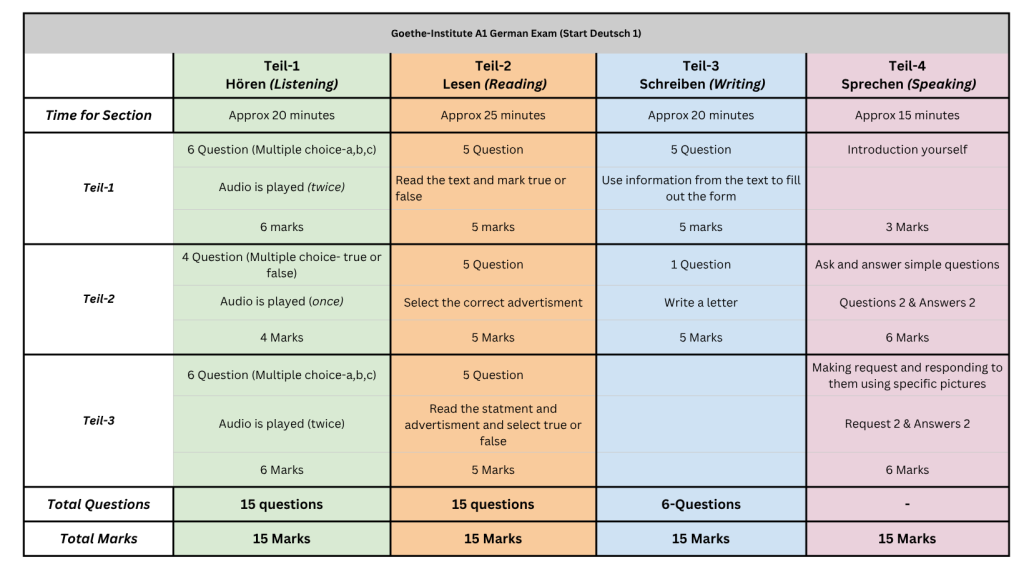
The Goethe A1 Exam is in four parts. All the four parts cover the four skills of
1-listening,
2-reading
3-writing
4-speaking.
We have referred the model question paper on Goethe Institute’s own website.

Let look in the format of the paper part by part.

1-Listening Section (Hören)

The Goethe A1 German listening exams last for total 20 minutes and is divided in three parts. The complete audio for the listening exam runs for over 17 to 18 minutes. The audio played is generally recorded voice and is clear and slower that everyday speech.

Listening Part One (Teils Eins):

In the Part one, you will hear six short audio clips, each audio clip is played twice. For every question you select the correct answer form the three given options (a,b or c). Each question comes with three pictures, which helps in the selecting the correct answer.

Listening Part Two (Teil Zwei):

There are four questions in this part (seven to ten).Each question has its own audio clip ,after listening to the audio clip ,you have to decide whether the statement given is true or false.Each audio clip is played twice as an announcement on the loudspeaker.

Listening Part Three (Teil Drei):

There are five questions in this part, you’ll hear five audio clips, each played twice. For every question, you must choose the correct answer from options a), b), or c). The recordings feature various telephone voicemail messages, and your task is to determine, based on what you hear, which of the three short options best answers the question.

2-Reading Section (Lesen)

The Goethe A1 German reading exams and the writing exam section last for total 45 minutes. It is recommended to spend about 25 minutes on reading and 20 minutes on writing.
The reading section is split in total three sections.

Reading Part (Teil Eins):

There are two short texts in the first part of the reading section. The first text is about 40 to 50 words and the second text is about 70 to 80 words long.
There are five questions in total two based on the first text and three based on the second text which one must answer with Richtig or Falsch.

Reading Part (Teil Zwei):

For questions six to nine, you will see two brief website descriptions (around 10–20 words each, with the web address shown). Each question presents a different simple situation.

Reading Part (Teil Drei):

In questions 11 to 15 of the model paper, you will be shown a picture of an information sign. You must interpret the sign to answer the question with “richtig” or “falsch.”

3-Writing Section (Schreiben)

The writing section is one of the parts of the reading section, because we get both the section at once. One should not spend more than 20 minutes on writing section. Both the sections in the writing sections should be written in small number of words and should follow clear structure. One of the key challenges in the writing section is to understand the information given in both the questions.

Writing Part (Teil Eins):

Part one of the writing section is a form filling exercise. In the question paper there is form with five blanks which needs to be filled after reading some basic small information, which is not more than 4 to 5 sentences.

Writing Part (Teil Zwei):

Part two is a short letter. One need to first read understand the question. Added to this there are three specific point given which need to be address in the letter in around 30 words

4-Speaking Section (Sprechen)

The speaking exam section of Goethe A1 lasts around fifteen minutes and has three main parts. There are up to four participants in a group with whom one must speak. There are also two examiners.one is the moderator and other is the assessor. The moderator guides the session and the assessor records the candidate’s performance.

Speaking Part (Teil Eins):

In Part one, one needs to introduce yourself with help of a prompt sheet. The sheet has all the information or pointers on which one need to answer in short sentences.
After the introduction, the moderator may ask one to spell any piece of information. One should be ready with the spellings of all the information shared in the introduction.

Speaking Part (Teil Zwei):

Part two will check one’s ability to ask and provide simple information about everyday topics such as(Essen,Trinken,Wohenende,Kleidung)
The first candidate asks the question and the second candidate responds to the question and this continues unless everyone has asked and answer the question.
For example, if you have the card: “Thema Essen uns Trinken. Beer” you could ask “Wo kann ich Beer trinken?” If you are asked this, you might answer: “In der Kneipe” Then the exercise repeats with a second everyday subject.

Speaking Part (Teil Drei):

Part Three checks one’s ability to ask and respond to questions in relation to common and everyday Objects.
For example, the prompt could display a photo or picture of an Apple without any accompanying text. You might ask a question,”Ein Kilo Apfel,bitte?” or respond,” Ja naturlich,bitte”. One needs to refer the model papers to understand the different photos and examples.

Top three German language institutes in Pune

German language is a widely spoken language in world it is the official language of many countries

Nowadays the scope of German language has increased because of globalization

Who can learn?

Anyone willing to learn German language is eligible to join the course whether graduate or undergraduate doesn’t matter students with any background can join the course there is a huge requirement of people having German language knowledge in MNC’S, healthcare, etc. Woman, housewife who wants to start their career in Germany can also learn.

Why should you learn German?

Millions of people across the globe are learning German here are some reasons:

Business growth: If you are company with German business partners then learning their native language will help you establish an effective communication with them. This will certainly improve your business relations.

Tourism and hospitality: learning German can help tour guides and hospitality staff to look after the tourist from Germany or other German speaking countries

Research: Germany is the third largest contributor in global scientific Research which makes German the second most widely used scientific language.

Communication: growth in global media and information technology has led to an increased need of multilingual Writers and translators. A lot of books are published in German and hundreds of websites use German for writing content.

Culture: learning German can bring you closer to culture, Music, Art and philosophy of people in German speaking country.

Job opportunities:

Knowledge of German language has opened up job opportunities in the field of education, Mass media, Entertainment, tourism, information technology and outsourcing. 

One popular job is translation the work of a translator is translator source language into a target language to do this, he/she should have a clear understanding of both the language. A number of big MNC’s and government organizations need translators. You are if you want highly skilled in translation then you can even work with the Indian national scientific documentation center (INSDOC), Delhi. German translators can also work with translation bureaus and global organizations like Uno and FAQ.

Here are the major career opportunities with learning German:

  • German language trainer: You can work as a language trainer with institutes and colleges.
  • German translator for me and government organizations: You can work with both private and government organizations by providing translation and interpretation services.
  • Tourism industry: You can work as an air Hostess in International Airlines.
  • Hospitality industry: You can work as a guest relations executive at hospitality management centers.
  • Media: You can work as a content writer for publishing media and websites.
  • Public relations: You can work as a representative with public relation agencies.

There are 3 top best German language institutes in Pune:

  1. GLTI- German language Training Institute in Pune
  2. Pune training institute
  3. 3PEAR – Pune

Institutes which focuses on small size batches to give more attention on each and every student personally. German language institutes with focus approach for professionals and has a weekend batches and only Sunday batches as well top cater professionals even having Saturday working. They only can attend Sunday batches to move ahead with competition.


SHOULD WE USE GOOGLE TRANSLATOR TO LEARN GERMAN?

A teacher will never encourage the students to use Google translator to learn German language because it can make terrible and funny mistakes but it is human nature to use tools that will make his life easy but Google translator is still far from perfect but it is getting better day by day.

So it is not whether you should or shouldn’t use Google translator but how and when

Easy solution

If we read a German text and then we are offered with the complete translation of the text in English serve on a silver platter no one will take the effort to breakdown and analyse the sentences will learn German the translation offered is too tempting it is like serving a person a sandwich on one hand an upgrade and some ingredients on the other hand.

Try to understand and make sense on your own

Try to identify the sentence construction in German

Try to find the meaning and understand the difficult words

This process will take more efforts than just translating the whole text. this process will slowly increase the skills note down all the new words learned also note down all the new grammar you have identified these notes you take in the process will take to learn better and it is important to keep log of everything do and revise it periodically.

Let the machine assist you for writing German text

This process will not only help you learn new expressions in the German language but also the new words in German.

Let Google translator assist you in writing. one should try to write and rewrite the English sentence in such a simplified way That the resulting German sentences are in line with the actual knowledge of German try to restrict yourself to the actual grammar and vocabulary that you will use when speaking.

A cautionary Note:-We are not recommending The use of Google translator always for writing of text. But if you want to use it wisely.